Stellarator and tokamak equilibrium, stability, and optimization suite built on pseudo-spectral methods and automatic differentiation.
🧭 New to fusion computing? The hands-on guides take you from zero to a first equilibrium, a first transport run, and a first neutronics model — each in under an hour.
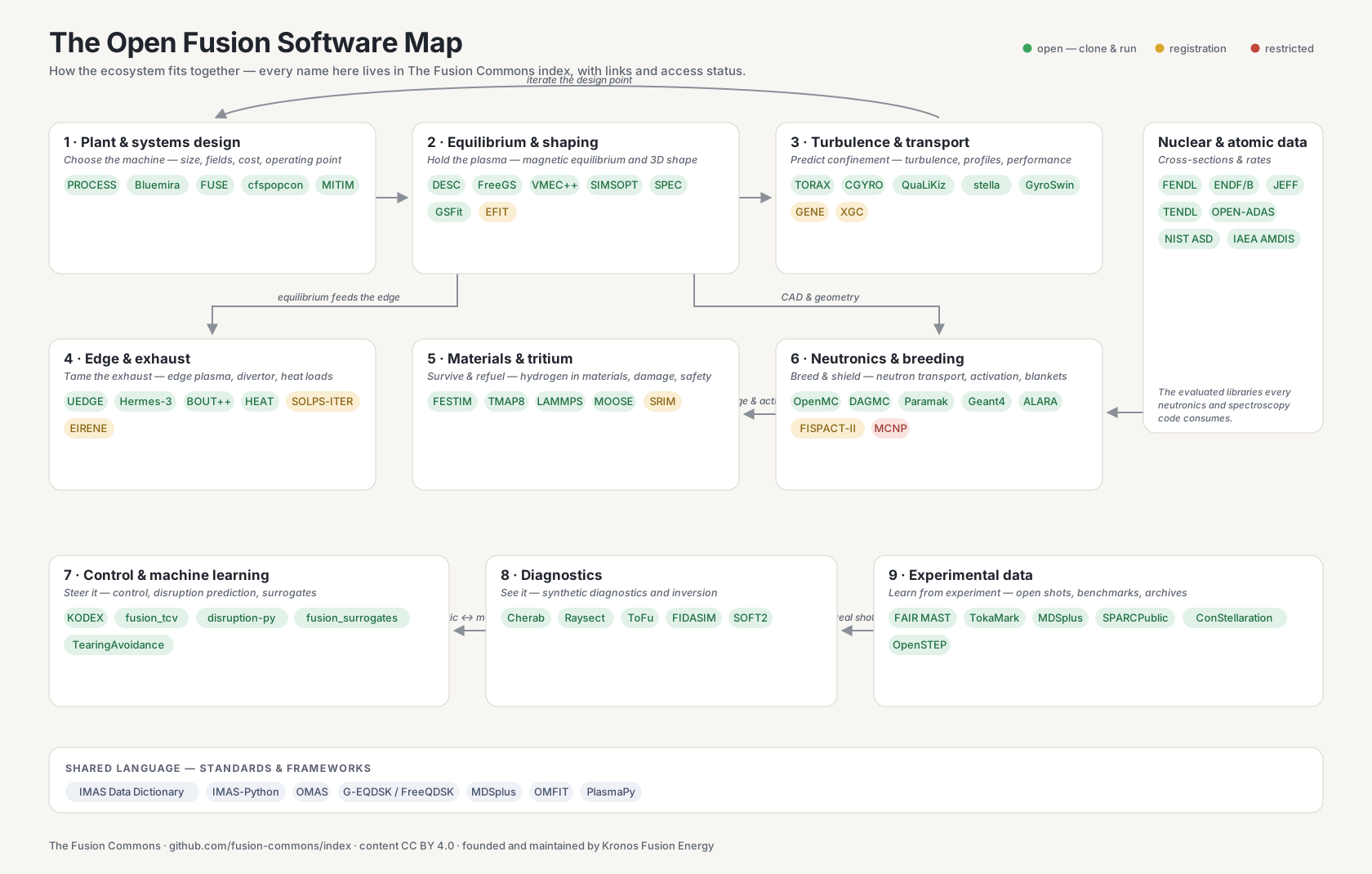
The Open Fusion Software Map — click to open full size. Every name on it is in the index below.
Simulation codes
Plasma equilibrium & MHD
Free-boundary Grad–Shafranov equilibrium solver for tokamaks, well suited to scenario design and control studies.
Evolutive free-boundary Grad–Shafranov simulator from UKAEA, validated on MAST-U and a standard backend for control and surrogate training pipelines.
Reader/writer for the G-EQDSK, A-EQDSK, and P-EQDSK equilibrium file formats.
Grad–Shafranov equilibrium reconstruction open-sourced by Tokamak Energy, with a real-time sibling (RT-GSFit) running in the ST40 control system.
GVECGitLab
Galerkin Variational Equilibrium Code from Max Planck IPP — flexible open 3D ideal-MHD equilibrium solver in the VMEC lineage.
Suite of tools for fusion simulation, including the TokaMaker Grad–Shafranov solver and 3D MHD capabilities.
Parallel version of the VMEC 3D ideal-MHD equilibrium code, the workhorse of stellarator equilibrium.
Stepped-Pressure Equilibrium Code — 3D MHD equilibria with islands and chaotic fields via multi-region relaxed MHD.
Proxima Fusion's from-scratch open reimplementation of the VMEC 3D MHD equilibrium code, built for modern stellarator optimization.
VMEC build with a Python wrapper and CMake tooling, maintained for the SIMSOPT optimization ecosystem.
The standard tokamak equilibrium reconstruction code from General Atomics; commonly run through OMFIT.
Nonlinear extended-MHD code for disruptions, ELMs, and 3D instabilities in divertor tokamaks.
High-order 3D extended-MHD code from PPPL for tokamak stability and disruption modeling.
Nonlinear 3D extended-MHD code used widely for macroscopic stability studies.
Choosing an equilibrium code
Editorial guidance for newcomers — start here, then read each code's documentation.
| Code | Geometry | First run | GPU | License |
|---|---|---|---|---|
| FreeGS | Tokamak (free boundary) | pip install, laptop | — | open |
| DESC | Stellarator + tokamak | pip install, laptop | (JAX) | open |
| TokaMaker (OFT) | Tokamak (free boundary) | build from source | — | open |
| VMEC (PARVMEC / VMEC2000) | Stellarator + tokamak (nested surfaces) | build from source | — | open |
| SPEC | Stellarator (islands & chaos) | build from source | — | open |
| EFIT | Tokamak (reconstruction from experiment) | via OMFIT | — | registration |
Gyrokinetics, turbulence & transport
General Atomics suite — CGYRO (gyrokinetic turbulence), TGLF (quasilinear transport), NEO (neoclassical), and TGYRO (transport solver).
Modern C/CUDA framework for gyrokinetic, Vlasov–Maxwell, and multi-moment fluid simulation on GPUs.
GKWBitbucket
Global and flux-tube nonlinear gyrokinetic code for turbulence in rotating plasmas.
Open GPU-ready semi-Lagrangian gyrokinetic library from CEA's GYSELA-X project.
QuaLiKizGitLab
Fast quasilinear gyrokinetic transport model, widely used inside integrated modeling loops and as a neural-network surrogate.
Operator-split gyrokinetic code built for stellarator turbulence and mixed implicit/explicit timestepping.
Flagship Eulerian gyrokinetic turbulence code (flux-tube to global, tokamaks and stellarators); free after signing a user agreement.
GS2Bitbucket
Pioneering flux-tube gyrokinetic code for tokamak and stellarator microinstability and turbulence studies.
Whole-volume gyrokinetic particle-in-cell code for edge and core, scaling to exascale machines.
Global electromagnetic gyrokinetic particle-in-cell code from EPFL's Swiss Plasma Center; source via collaboration agreement.
Choosing a gyrokinetic code
Editorial guidance for newcomers — start here, then read each code's documentation.
| Code | Geometry | Approach | GPU | License |
|---|---|---|---|---|
| QuaLiKiz | Tokamak | Quasilinear (fast, reduced) | — | open |
| CGYRO (GACODE) | Tokamak, flux tube | Eulerian, nonlinear | — | open |
| Gkeyll | Tokamak + mirror, incl. edge | Continuum, full-f capable | — | open |
| stella | Stellarator + tokamak | Eulerian, operator-split | — | open |
| GKW | Tokamak, global + flux tube | Eulerian, nonlinear | — | open |
| GENE | Tokamak + stellarator, global | Eulerian, nonlinear | — | registration |
| GS2 | Tokamak + stellarator, flux tube | Eulerian, nonlinear | — | registration |
| XGC | Whole volume, incl. edge | Particle-in-cell, full-f | — | registration |
Integrated modeling & systems codes
Integrated design framework for fusion power plants — reactor geometry, magnets, balance of plant, and optimization.
Fast 0-D plasma operating-contour (POPCON) analysis from Commonwealth Fusion Systems.
Whole-facility fusion simulator from General Atomics — plasma, engineering, and costing in one differentiable Julia stack.
Anchor-tested Python research engine reproducing the published Kronos Fusion Energy physics register end-to-end.
CEA-IRFM's fast integrated tokamak scenario and transport simulator, released under the CeCILL-C license.
MIT integrated-modeling toolbox including PORTALS — surrogate-based optimization that accelerates high-fidelity core transport predictions.
UKAEA systems code for self-consistent fusion power plant design points and trade studies.
Differentiable tokamak core transport simulator in JAX from Google DeepMind, built for fast scenario optimization and ML coupling.
One Modeling Framework for Integrated Tasks — the glue framework connecting dozens of fusion codes and experimental databases.
The reference tokamak time-dependent transport analysis and prediction code, run as a service by PPPL.
Choosing an integrated modeling or systems code
Editorial guidance for newcomers — start here, then read each code's documentation.
| Code | Scope | First run | Language | License |
|---|---|---|---|---|
| cfspopcon | 0-D operating space (POPCON) | pip install, laptop | Python | open |
| TORAX | 1-D core transport, differentiable | pip install, laptop | Python | open |
| PROCESS | Whole-plant systems optimization | build from source | Python/Fortran | open |
| Bluemira | Plant design & engineering | conda environment | Python | open |
| FUSE | Whole facility, differentiable | Julia package | Julia | open |
| OMFIT | Framework gluing many codes | registration | Python | registration |
| TRANSP | Experiment analysis & prediction | hosted service | Fortran | registration |
Edge, scrape-off layer & divertor
Framework for plasma fluid and turbulence simulation in general curvilinear geometry, the base for many edge codes.
Hot-ion multifluid drift-reduced model for tokamak edge and scrape-off-layer transport, built on BOUT++.
1D divertor leg model of plasma–neutral interaction and detachment, built on BOUT++.
2D fluid code for plasma and neutrals in the tokamak edge, from LLNL, with a Python interface.
PPPL Monte Carlo neutral-transport code for fusion edge plasmas.
Kinetic Monte Carlo neutral particle and radiation transport code, the neutrals engine inside SOLPS-ITER.
EPFL's Global Braginskii Solver for edge and scrape-off-layer plasma turbulence in diverted geometries.
CEA-IRFM and Aix-Marseille edge-plasma transport and turbulence code including wall geometry, recycling, and impurity physics.
The standard coupled plasma/neutrals code package for divertor and scrape-off-layer design, maintained by the ITER Organization.
Disruptions & runaway electrons
Disruption Runaway Electron Analysis Model from Chalmers — the standard open tool for simulating runaway-electron generation and mitigation.
Synthetic synchrotron diagnostic from Chalmers reproducing camera images and spectra of runaway-electron radiation.
Particle-in-cell & kinetic codes
Widely used relativistic particle-in-cell code for laser–plasma interaction and kinetic physics.
The widely used UCLA/IST relativistic particle-in-cell code, historically agreement-only and now public under AGPL-3.0.
Fully relativistic, many-GPU particle-in-cell code with best-in-class performance.
Collaborative open particle-in-cell code for fusion, laser–plasma, and astrophysical kinetic simulation.
Los Alamos 3D relativistic kinetic particle-in-cell code, built for extreme scale.
Exascale mesh-refined particle-in-cell code (2022 Gordon Bell Prize) for kinetic plasma and accelerator modeling.
Stellarator design & optimization
Transforms stellarator equilibria to Boozer coordinates, with Python bindings.
Flexible optimized coil design using space curves — finds buildable coils for stellarators.
Simplified stellarator CAD models published by Proxima Fusion as an open engineering and design resource.
Near-axis expansion for rapid design of quasisymmetric stellarator configurations.
Regularized winding-surface coil optimization for stellarators.
Flexible stellarator optimization framework tying together VMEC, SPEC, coil design, and gradient-based optimization.
The classic stellarator equilibrium optimization suite, including BEAMS3D and DIAGNO.
Alternative concepts
0-D scoping model for transport in centrifugally confined magnetic mirrors, used for the CMFX experiment at the University of Maryland.
Green's-function equilibrium and coil-design code used to generate magnetic-mirror equilibria for the WHAM experiment.
Kinetic FRC and Z-pinch studies in the open literature largely run on the particle-in-cell codes above (WarpX, Gkeyll), and the Open FUSION Toolkit descends from spheromak research — the entries here are concept-specific tools.
Heating, current drive & fast particles
High-performance Monte Carlo orbit-following code for fast ions, neutral-beam injection, and wall-load studies in tokamaks and stellarators.
CompX's 3D Fokker–Planck collisional/quasilinear code for RF and neutral-beam heating, now openly published; the CQL3D-m variant serves mirror machines.
All-frequencies ray-tracing code for RF wave propagation in plasmas, the standard companion to CQL3D.
Finite-element RF wave simulation framework (built on MFEM) used for ICRF antenna-to-core modeling.
Beam-tracing code for Doppler backscattering and microwave beam propagation in fusion plasmas.
Neutronics, activation & shielding
Activation, decay-heat, and dose analysis code designed for fusion energy systems.
Direct Accelerated Geometry Monte Carlo — run neutronics directly on CAD geometry with OpenMC, MCNP, and more.
CERN's general-purpose particle transport toolkit, used for shielding and detector studies.
Worked open OpenMC R2S example — activation, waste classification, and shutdown dose for a breeder blanket.
Community Monte Carlo neutron and photon transport code — the open standard for fusion neutronics.
Parametric CAD models of fusion reactors, ready for neutronics workflows.
Nuclear engineering toolkit — nuclear data, cross sections, transmutation, and mesh utilities.
UKAEA inventory code for activation, transmutation, and waste — the fusion-standard companion to TENDL data.
Continuous-energy Monte Carlo transport and burnup code from VTT with strong fusion adoption.
The reference general Monte Carlo N-Particle transport code; export-controlled, distributed through RSICC.
Materials & fuel cycle
Finite-element hydrogen/tritium transport in materials — trapping, permeation, and thermal fields.
Molecular dynamics workhorse for radiation damage and plasma-facing materials studies.
Idaho National Laboratory's multiphysics finite-element framework underlying many fusion materials and blanket tools.
Tritium Migration Analysis Program, rebuilt on MOOSE — the standard for fuel-cycle tritium safety analysis.
Stopping and Range of Ions in Matter — the classic ion-implantation and sputtering tables; free binaries, closed source.
Plant engineering & plasma-facing components
Commonwealth Fusion Systems' quasi-steady electromagnetics library — Biot–Savart, filamentized coils, and Grad–Shafranov utilities for tokamak design.
Open thermophysical property library covering cryogenic fluids such as helium and hydrogen; used in Bluemira's cryogenics and coolant calculations.
GeN-FoamGitLab
OpenFOAM-based multiphysics solver for thermal-hydraulics, thermal-mechanics, and neutronics, relevant to balance-of-plant and liquid-metal blanket analysis.
Heat flux Engineering Analysis Toolkit mapping 3D plasma heat and particle loads onto real CAD of plasma-facing components.
Open database of measured critical-current characteristics of commercial REBCO/HTS wires — a standard data source for fusion magnet conductor design.
UKAEA library for magnetic field-line following and power-deposition mapping onto CAD plasma-facing surfaces, the approach underlying ITER's SMITER framework.
CAD-to-DAGMC meshing library for neutronics workflows, originally from Thea Energy and now community-maintained.
Thea Energy's tool for in-notebook 3D visualization of DAGMC geometry and OpenMC tallies in stellarator neutronics workflows.
Plasma control, machine learning & quantum
Open workflow from MIT PSFC for building disruption-prediction databases from tokamak shots.
Machine-agnostic benchmarking framework for ML disruption predictors across Alcator C-Mod, DIII-D, and EAST — the companion to disruption-py.
Fusion Recurrent Neural Network — deep learning for disruption prediction from PPPL.
Google DeepMind's library of JAX surrogate transport models, including the QuaLiKiz-trained QLKNN networks used by TORAX.
Reference environment and agent-interface code from DeepMind's Nature 2022 deep-reinforcement-learning magnetic control of TCV plasmas.
The Kronos family of codes — a fleet of benchmarked AI/ML fusion surrogates and quantum tools spanning transport, magnet quench warning, disruption prediction, breeding, and control, each release archived with citable DOIs.
Runnable quantum-computing-for-fusion codes with a white paper — honest simulators today, pluggable into real quantum hardware as the field matures.
Distributed control-system framework and UI toolkit published by First Light Fusion from its experimental-controls stack.
Training code for the Nature 2024 deep-RL tearing-instability avoidance controller demonstrated on DIII-D.
Also listed under integrated modeling — its differentiability makes it a natural base for control and ML research.
Diagnostics & synthetic diagnostics
Spectroscopic modeling framework for synthetic diagnostics, built on the Raysect ray-tracer.
Synthetic fast-ion D-alpha and neutral-beam diagnostic modeling.
Scientific ray-tracing engine powering Cherab's synthetic camera and spectrometer views.
Open library for tomography and synthetic diagnostics in fusion devices, used for bolometry and soft-X-ray inversion workflows.
Inertial confinement & high-energy-density
Multiphysics adaptive-mesh radiation-hydrodynamics code with a long heritage in HED and laboratory astrophysics.
Multiphysics radiation-MHD code from the Flash Center — a workhorse for magneto-inertial and magnetized HED fusion simulation.
The production ICF radiation-hydrodynamics codes (HYDRA, xRAGE, and kin) are export-controlled and not publicly distributed; EPOCH, Smilei, and WarpX above cover much of the open kinetic side of HED science.
General plasma frameworks & utilities
GitHub organization of open fusion neutronics tools and workflows surrounding OpenMC, DAGMC, and Paramak.
The data acquisition and storage system used by most magnetic fusion experiments worldwide.
Lightweight scalable finite-element library from LLNL, the numerical engine under several fusion codes.
Ordered Multidimensional Array Structure — Python data-schema layer implementing the ITER IMAS ontology.
The community Python package for plasma physics — formulary, particles, diagnostics, and simulation primitives.
StruphyGitLab
Structure-preserving hybrid kinetic-fluid plasma simulation package from Max Planck IPP.
Data
Open experimental & simulation datasets
UKAEA's open data service for the MAST spherical tokamak — thousands of shots, browsable and downloadable.
The IAEA's portal of evaluated nuclear data libraries and related services.
ITER's open-source releases, including the IMAS data infrastructure and physics codes.
Public data release of the STEP prototype fusion power plant tokamak design from UKAEA.
Commonwealth Fusion Systems' public SPARC design data — equilibria, profiles, and reference scenarios.
CERN-hosted open repository where fusion datasets, code archives, and supplementary material receive citable DOIs; Kronos Fusion Energy's open research archive is published here.
Machine learning datasets & models
ConStellarationHugging Face
Proxima Fusion's open dataset of quasi-isodynamic stellarator boundaries with equilibria and performance metrics, the basis of an open optimization benchmark.
Fusion Equilibrium ChallengeHugging Face
Challenge dataset for predicting plasma magnetic equilibrium from control inputs and non-magnetic diagnostics on DIII-D and MAST data.
GyroSwinHugging Face
Pretrained 5D neural surrogate for nonlinear gyrokinetic plasma turbulence, roughly a thousand times faster than the code it emulates.
Open fusion-ML benchmark suite from the KODEX family — citable tasks on gyrokinetic turbulence, MAST disruption prediction, and flux reduced-order modeling, with fixed splits, metrics, and baselines to beat.
NearAxisStellaratorsHugging Face
Large dataset of stellarator configurations generated with the pyQSC near-axis expansion, pairing design parameters with derived properties for surrogate training.
Pedestal PredictorHugging Face
DIII-D-trained ensemble predicting pedestal temperature, density, and rotation values, packaged as self-contained ONNX bundles for real-time inference.
TokaMarkHugging Face
Benchmark packaging harmonized diagnostic signals from over ten thousand real MAST tokamak shots into task-ready evaluations for AI models.
TokaMindHugging Face
Multi-modal Transformer foundation model for tokamak plasma dynamics, pretrained on MAST data via TokaMark.
Atomic, molecular & nuclear data
The US evaluated nuclear data file, from Brookhaven's National Nuclear Data Center.
Fusion Evaluated Nuclear Data Library — the IAEA-curated nuclear data library for fusion neutronics.
Atomic and molecular data for fusion, including the ALADDIN database and CollisionDB.
The Joint Evaluated Fission and Fusion nuclear data library from the OECD Nuclear Energy Agency.
Reference wavelengths, energy levels, and transition probabilities.
Freely downloadable subset of the Atomic Data and Analysis Structure — ionization, recombination, and radiation rates for fusion plasmas.
TALYS-based evaluated nuclear data library, the standard companion to FISPACT-II activation calculations.
Standards & interoperability
The de-facto G-EQDSK equilibrium exchange format, implemented cleanly (also listed under equilibrium).
The ITER-standard ontology for describing fusion experiments and simulations.
Pure-Python library for reading and writing IMAS data structures.
Practical Python implementation of the IMAS schema over NetCDF/HDF5/JSON (also listed under frameworks).
Learning
Textbooks & foundational papers
The classic gentle introduction to plasma physics.
Comprehensive reference on the engineering systems of magnetic fusion devices.
The standard first textbook for fusion-oriented plasma physics.
Graduate text on plasma physics fundamentals for fusion.
The community-consensus physics basis for burning-plasma tokamaks, open access in Nuclear Fusion.
Standard graduate textbook spanning the physics and technology of magnetic confinement fusion.
The encyclopedic reference on tokamak physics and engineering.
Courses, schools & lectures
UKAEA's two-week summer school in plasma physics and fusion, running since 1965.
Program overviews and primers from the US fusion science office.
Introduction to plasma physics and fusion applications from EPFL's Swiss Plasma Center; free to audit on edX.
The European Fusion Education Network — master's programs, PhD events, internships, and teaching material.
Annual themed school for young fusion scientists and engineers, organized by ITER and Aix-Marseille University.
Approachable seminar-style introduction to fusion from MIT.
Full graduate course materials, free.
Annual one-week plasma physics school with archived lectures.
Hands-on workshops
Self-paced Jupyter workshop covering OpenMC, DAGMC, and Paramak for fusion neutronics.
Notebook examples for computational plasma physics in Python.
Community
Regulation & policy
Plain-language overview of US fusion licensing frameworks and deployment pathways from Clean Air Task Force.
The official US proposed rule regulating commercial fusion under the byproduct-material framework (10 CFR Part 30) rather than as fission reactors.
The UK's regulatory decision — the first country to legislate fusion-specific regulation, under the Environment Agency and HSE rather than nuclear site licensing.
Organizations, news & sibling lists
The American Nuclear Society's Fusion Energy Division, host of the biennial TOFE conference.
The main US plasma physics society and annual meeting.
The European fusion research consortium.
Tracking of fusion companies, projects, and technologies.
The trade association of private fusion companies; publishes the annual industry report.
The IAEA's fusion hub, including the Fusion Device Information System and Fusion Energy Conference materials.
News from the world's largest fusion project.
The main Reddit community for fusion energy discussion.
US fusion outreach and education hub with explainers, K-12 materials, news, and a careers portal.
Live feeds of open fusion repositories: GitHub topics nuclear-fusion and plasma-physics.
Sibling lists: awesome-nuclear · awesome-ML-in-plasma-physics · List of plasma physics software (Wikipedia).
Getting access to licensed codes
Many of the field's most important codes are free for research but require a signed agreement. This is normal, and turnaround is usually days to weeks. The front doors:
| Code | How to get it |
|---|---|
| DEGAS 2 | Complete the licensing form at w3.pppl.gov/degas2 |
| EFIT | Via General Atomics; commonly run through OMFIT |
| EIRENE | Request from the EIRENE team at eirene.de |
| FISPACT-II | UKAEA license, free for academic use |
| FLASH | Register with the Flash Center at flash.rochester.edu |
| GBS | Request from EPFL's Swiss Plasma Center via gbs.epfl.ch |
| GENE | Sign the user agreement at genecode.org |
| GS2 | Request access at bitbucket.org/gyrokinetics (also hosts GX) |
| JOREK | Via consortium membership at jorek.eu |
| M3D-C1 | Request access from PPPL |
| NIMROD | Contact the NIMROD team |
| OMFIT | Free registration form at omfit.io |
| Serpent | VTT license via national distribution centers |
| SOLEDGE3X | On request via the contact address at soledge3x.com |
| SOLPS-ITER | Distributed under ITER Organization user agreement |
| SRIM | Free binaries from srim.org (closed source) |
| TRANSP | Run as a service; request a PPPL account |
| XGC | Request access from PPPL |
| MCNP | Export-controlled; RSICC handles eligibility |
| ORB5 | Via collaboration agreement with EPFL's Swiss Plasma Center |